
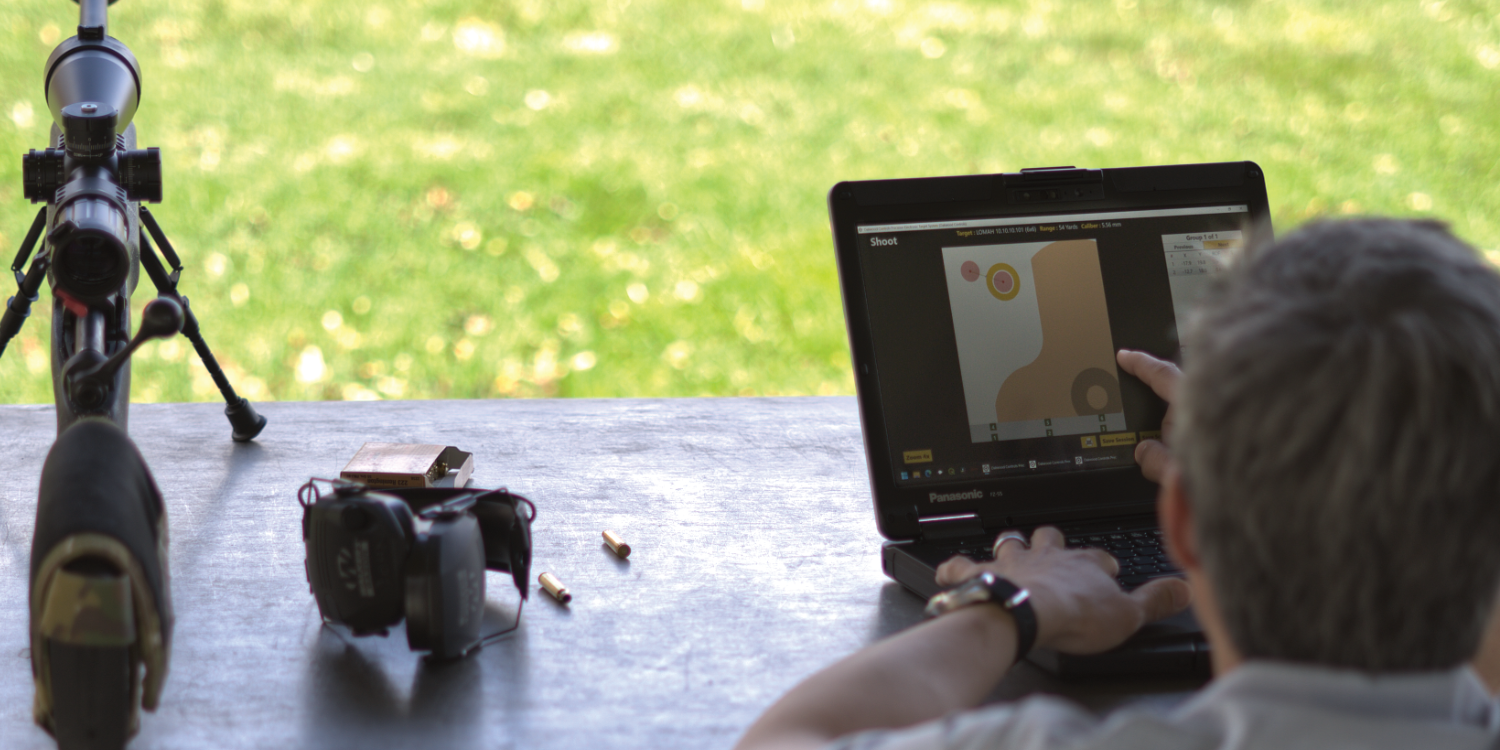
For most programs, the choke point in live fire training isn’t skill. It’s time.
This is where real-time shot feedback at the firing line stops being “a cool feature” and becomes a direct economic driver for training throughput, qualification schedules, and sustainment cost posture.
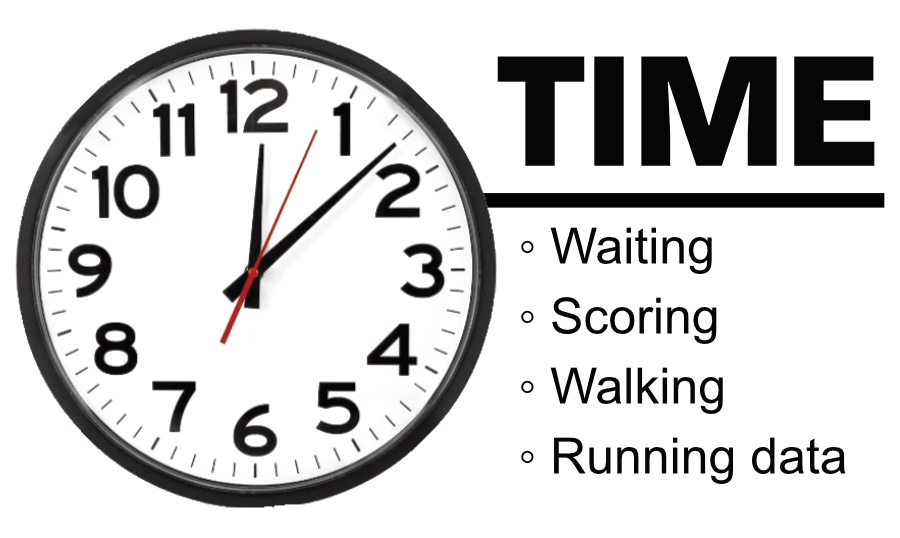
Procurement typically frames feature sets by capability. Trainers frame them by friction. Real-time feedback solves friction at scale. That means it also solves budget efficiency at scale. Live fire isn’t just a marksmanship exercise. It is a pipeline.
And pipelines are measured not only by accuracy but by velocity.
Slowing down is expensive.
Training units, instructors, and RSOs all know the scenario:
- Shooters fire their string
- Then they wait
- An RSO walks targets or they wait for scoring return
- Notes are taken
- Corrections are verbalized after the fact
By the time the shooter receives feedback, the shot sequence is a memory rather than a live neural imprint. The moment to correct is gone. And every one of these micro delays compounds over hours, over qualification cycles, over throughput demand, and over battalion scale events.
This means a system that delays feedback is functionally raising the cost of every round fired, every lane run, and every qualification event. The economic drain is not obvious in a single session. It absolutely is over a year.
Every minute wasted is training budget being converted into idle time instead of skill advancement.
The cognitive advantage that directly affects budget.
Real-time feedback produces a specific learning effect that has been validated in every domain of skill acquisition research: immediate correction dramatically accelerates retention and performance improvement.
When instruction can be applied while the shooter is still “in the moment,” the brain updates patterns faster. That means shooters improve in fewer iterations. That means fewer rounds burned to reach competency. That means fewer hours needed to move from early skill to qual-ready consistency. This is what makes real-time feedback a true throughput accelerator.
Throughput efficiency compound math.
Imagine a training block with 30 shooters over a full day. Even if real-time feedback recovers only 15 seconds per shooter per iteration across the day, the cumulative savings becomes hours. And that is a conservative time-frame.
At scale, those saved hours compress qualification cycles. They allow additional lanes to run more efficiently, reduce operational drag, and psychological fatigue that RSOs and instructors can experience when teaching and correcting with stop-and-wait feedback loops.
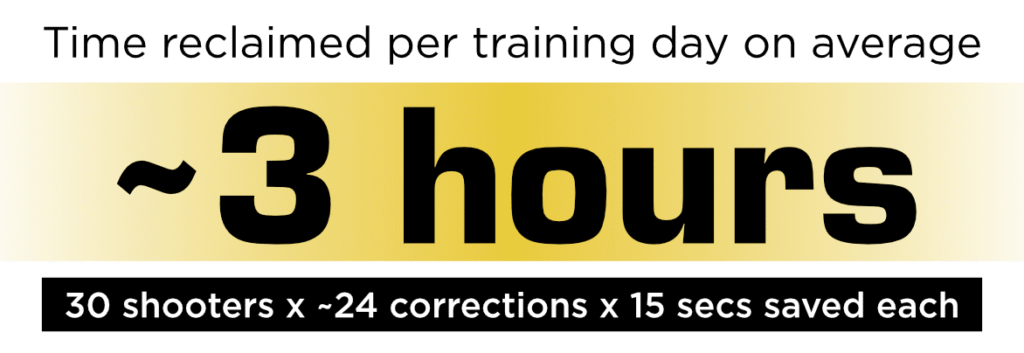
The procurement implication is simple: systems that accelerate feedback timelines should be evaluated not as training conveniences, but as time ROI multipliers. Real-time feedback gives time back.
Unstructured downtime is where programs bleed quietly.
Budget overruns rarely show up as line items. In live fire environments, they show up as delays: extra training days, squeezed instructor bandwidth, operational cycles compressed into worse timelines. These stay invisible until someone retroactively discovers them.
Real-time feedback systems close that gap by keeping shooters in flow, freeing instructors to coach instead of administrate. This is not soft ROI. It’s the direct mechanism through which qualification pipelines move faster without lowering standards. That reframes the question acquisition officers and evaluation boards should be asking. Not “how advanced is this target system,” but “how fast can this system move a cohort of shooters toward stable qualification readiness, without adding training days or manpower overhead?” Systems that can’t materially accelerate throughput are cost multipliers, no matter what their spec sheet says. The future of targeting system evaluation belongs to throughput-based analysis, not spec-based marketing.
The bottom line on real-time feedback.
Real-time feedback isn’t a convenience feature. It’s a structural training advantage that shapes qualification efficiency, instructor workload, and sustainment cost. Any system claiming advanced live fire capability has to prove it can accelerate skill acquisition inside the training window, not after it.
Programs that adopt real-time feedback reach consistent mastery faster, with less drag. In the current fiscal environment, that’s not a performance edge. It’s a strategic necessity.